
Errand of Mercy
Flash fiction: historically inspired war stories again (1220 words)
Welcome to The Story Scrapbook, a fiction newsletter by E.B. Howard. If you’re new in town, check out my Fiction Directory for navigation.
Have been very frustrated with my serials lately, so I spent yesterday writing this instead. “Errand of Mercy” is one of my rare standalone items, dashed off as such things usually are on the august occasion of FLASH FICTION FRIDAY. I’m not sure I fit the brief at all (“a happy return”, he says), but it was inspired by the prompt to begin with. See all the details at Gibberish.
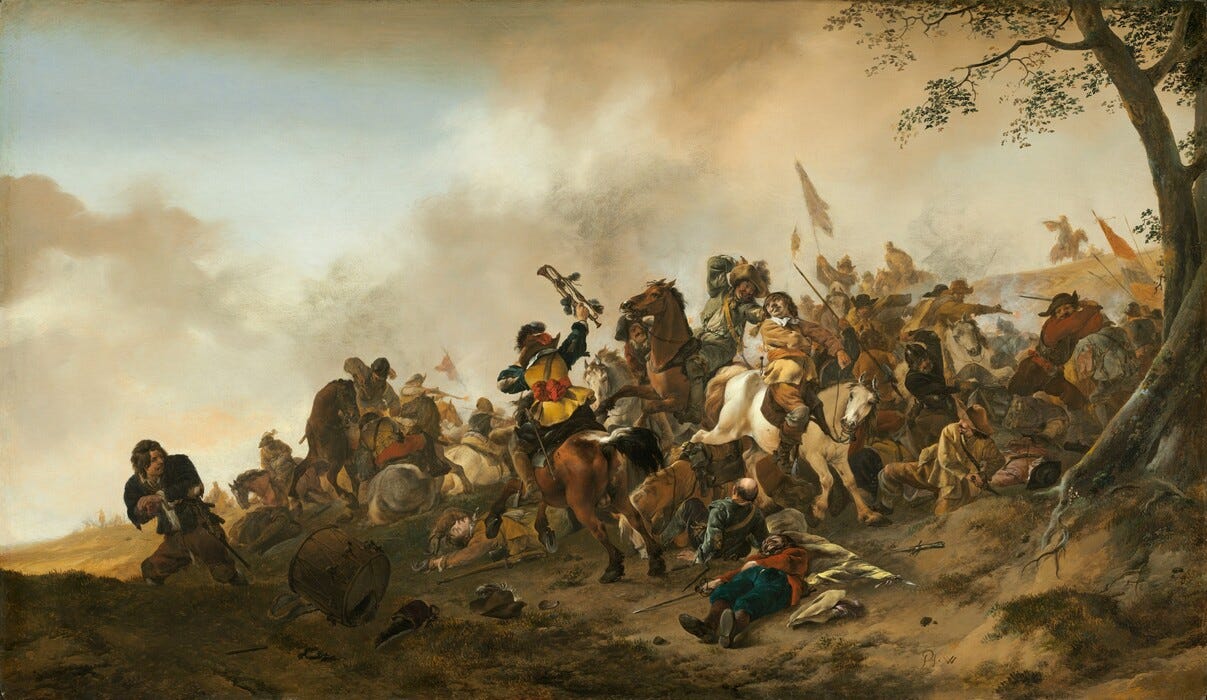
The road leading to the hillside villages was poor, nothing more than a worn dirt path between frostbitten fields, and Asta’s teeth clattered in her mouth as the donkey-cart rolled along it. Pained moans, one in a gasping voice and another low and rattling, issued from the back of the open cart at each bump in the road.
“Slow down there, old man,” called a hard voice from behind them. Down on the path, Asta’s father raised a hand in acknowledgement and reined back his beast to a gentler pace. Asta turned in her seat on top of the cart to give a sour look, the worst a twelve-year-old girl could manage, to their taskmaster. The man didn’t even look at her, but kept his eyes on the two bodies curled in the straw. He was a soldier returning from campaign; not an officer, a plain man like themselves; but clearly a veteran, for he had a face that looked as though it had been raked by a harrow. The repellent ugliness of that face was the first thing Asta had noticed when he hailed them on the road to market, demanding the use of their cart for a morning’s journey. The two broken wretches he had with him, he had said, were comrades of his whose wounds had turned; they had made their way this far, but could walk no longer. It would only be a few hours’ travel, he had said, to the village they had started off from months ago. In God’s name, would they not aid him?
Papa had not protested. But there would be no room in the cart, of course, for the market crops. “We will return for them,” he had told her as he changed the load. “Else God will provide.”
Asta ground her teeth, feeling the newest of them catch against each other. She thought of the hard-shelled squash and fat horseradish left arranged under the roadside hedge to be carried away by thieves, or perhaps to rot uncared for if this pop-eyed devil was to knife them in the back and run. Her father’s work, her work—their desperate prayers for rain and sun—the coin and barley they would have taken in trade—and the man simply walked there, murmuring placidly over Jackin the donkey as if they were still on their way to market!
The seat dropped from beneath her and then bounced up to smack her rear as the cartwheels fell into a deep rut and stuck there, halting their progress. Asta drew herself up again stiffly, ignoring the single whining groan from their cargo. She stared straight ahead at Jackin’s flicking ears, pretending also not to notice Papa and the veteran straining to lift the cart free.
The grunting and creaking stopped, and that ugly raked-over face appeared at her side. “Little girl, you must walk from here.”
“I’m surely no great burden—”
“Get out of the cart, Asta,” Papa said.
Asta scowled at him as she slid from the seat; saints only knew why, but she had expected him to defend her. Without her weight at the front, the two men pulled the wheels up smoothly, and Papa whistled to Jackin to walk on. There was a great clatter and a whimpering noise as the rear wheels followed through the rut and back onto the flat dirt.
She walked quickly past the lot to join her father beside the donkey. “What’s the point making me walk? I think one of ’em’s dead; could have just tipped him out,” she said. “I hope the other one dies too. Serves them right.”
“Asta. Don’t speak so.”
“Whyn’t I do? I don’t see how it’s any business of honest folk whether they get anywhere, murdering devils that they are. Whyn’t you tell him to carry his own wounded and be damned?”
“’Tis the will of our Lord that His people do each other mercy,” Papa said. “Think yourself better than a Cyrene or a Samaritan, daughter? And them of our own folk, besides. Why—” He cast a quick, distant look over his shoulder, toward the groaning burden that had displaced their harvest. “One might have been your brother.”
Asta pressed her lips together in silenced fury, and thought as if to scream that there must be no men left in the world worthy of the name. She hated them all—hated the rake-faced veteran, and the soldiers with their clotted lifeblood and stinking sores, and her soft-hearted priest-prating father, and her brother who had gone to the wars before the planting and left her to do everything else. She would have made a better man than all of them put together. Mercy! Even a girl could see that mercy was a weakness that struggling people could ill afford.
The road worsened further as they moved into the hills, its surface already scarred by harvest-time storms. While the sun slowly climbed overhead, Papa and the veteran stopped again and again to guide the cart around rocks and over rain-cut gullies, Asta sullenly picking her way on before them. At length, low walls began to appear, and finally the village’s clustered roofs. It looked very much like home, but she knew none of the faces that trickled and then flooded into the road to meet them, pressing in on all sides with greetings and thanks and demands for news. Asta turned her eyes aside and let the men get on with it.
They dealt with the corpse first. The veteran climbed up into the cart and came down again carrying a lolling bundle of limbs, which he handed into the arms of a strapping boy while an old woman swaddled in uncountable layers of shawls wailed at the gate. As they started off again, a girl of Asta’s own age ran by her and leapt onto the turning wheel in order to scramble into the back of the cart with a thin cry.
“He lives! Mama, he lives!”
Choking, Asta broke toward the road again and threw herself down in the dust behind a goose house, letting the birds’ shrieking drown out every other sound.
Papa collected her some time later. He was in high spirits and fairly sloshing with ale, and he showed her a few coins put together in gratitude while he chattered on idly about this and that secondhand acquaintance he’d discovered. Asta rode beside him in silence. The money they had still wouldn’t buy supplies for the winter, unless—perhaps unless her brother did not come home. She had been planning it all as if he would, without ever thinking it through.
Asta looked into the sky, figuring in her head. The sun was high, but after that delay they would be lucky to make it home before dark. Next week, she would take whatever could be spared and go along with another family to market, without Papa. She might yet be able to scrape enough together, just in case.
“See that, you little scold!” Papa cried jovially as Jackin finally trotted up again to the spot where they had left the main road. “What said I, eh. My Lord Baron may short his laborers their wages, but my Lord God never does. Not a root of it missing. Help me load this in, now, and we’ll go home.”
Thanks for reading. If you enjoyed this story, you might like my last flash fiction post, “New Here.” ~700 words, historical fantasy. In the leanest time of the year, an army bargains for passage.

Or visit the directory to see all my published work.

You are SO GOOD at historical dialogue!! Also, ouch. 💔
What a great story!! It reminds me so much of the historical American Girl stories - putting you in a time in history from the eyes of a child.